
Opening Wednesday, January 14th, Qualia Contemporary Art presents Hung Liu: Mixed Mediations and Guillermo Galindo: Tortoise, two concurrent exhibitions on view in the gallery.
Details on both exhibitions are available below.
Hung Liu:Mixed Mediations
Village Sketches, Studio Poses, and Countryside Self-Portraits in China
Hung Liu: Mixed Mediations is a solo exhibition of never-before-seen work by celebrated Chinese-American artist Hung Liu (1948 – 2021), conceived of jointly by Liu’s late husband, the art critic Jeff Kelley, and Dorothy Moss, PhD, Director of the Hung Liu Estate, in collaboration with the gallery. The exhibition highlights Liu's innovation and experimentation with printing processes while honoring her historical subjects by bringing visibility to those who were at risk of being forgotten.
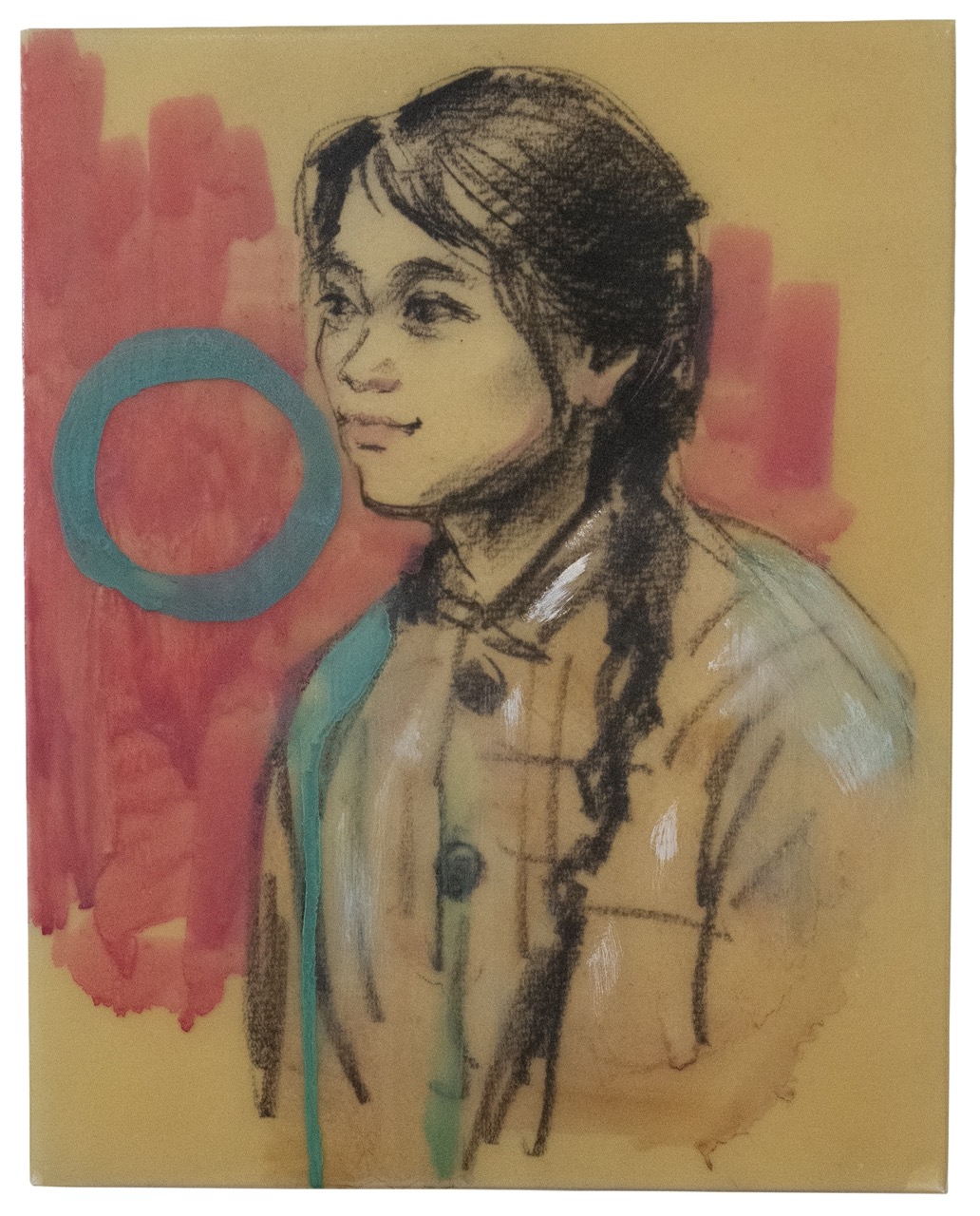
Hung Liu, Childhood Sketch #22, 2014. Mixed media (resin on wood panel with paint), 13 ½ x 11 x 2 in.
During the Cultural Revolution in China, Hung Liu worked from 1968 to 1972 as a peasant farmer in the countryside northeast of Beijing. As an artist, she sketched whenever possible, producing quick yet incisive likenesses of her fellow villagers. Some drawings were completed on the spot, while others were refined years later in the studio. Liu also owned a German 120 camera with a Carl Zeiss lens, given to her by a young man about to be sent to a military labor camp. With no prior photographic training, she taught herself to shoot, develop, and print black-and-white photographs. During her years in the countryside, she photographed fellow villagers—many of whom had never been photographed before. At times, she staged photographs of herself, such as sitting on a washed-out bridge, along a riverbank, or painting in the hills.
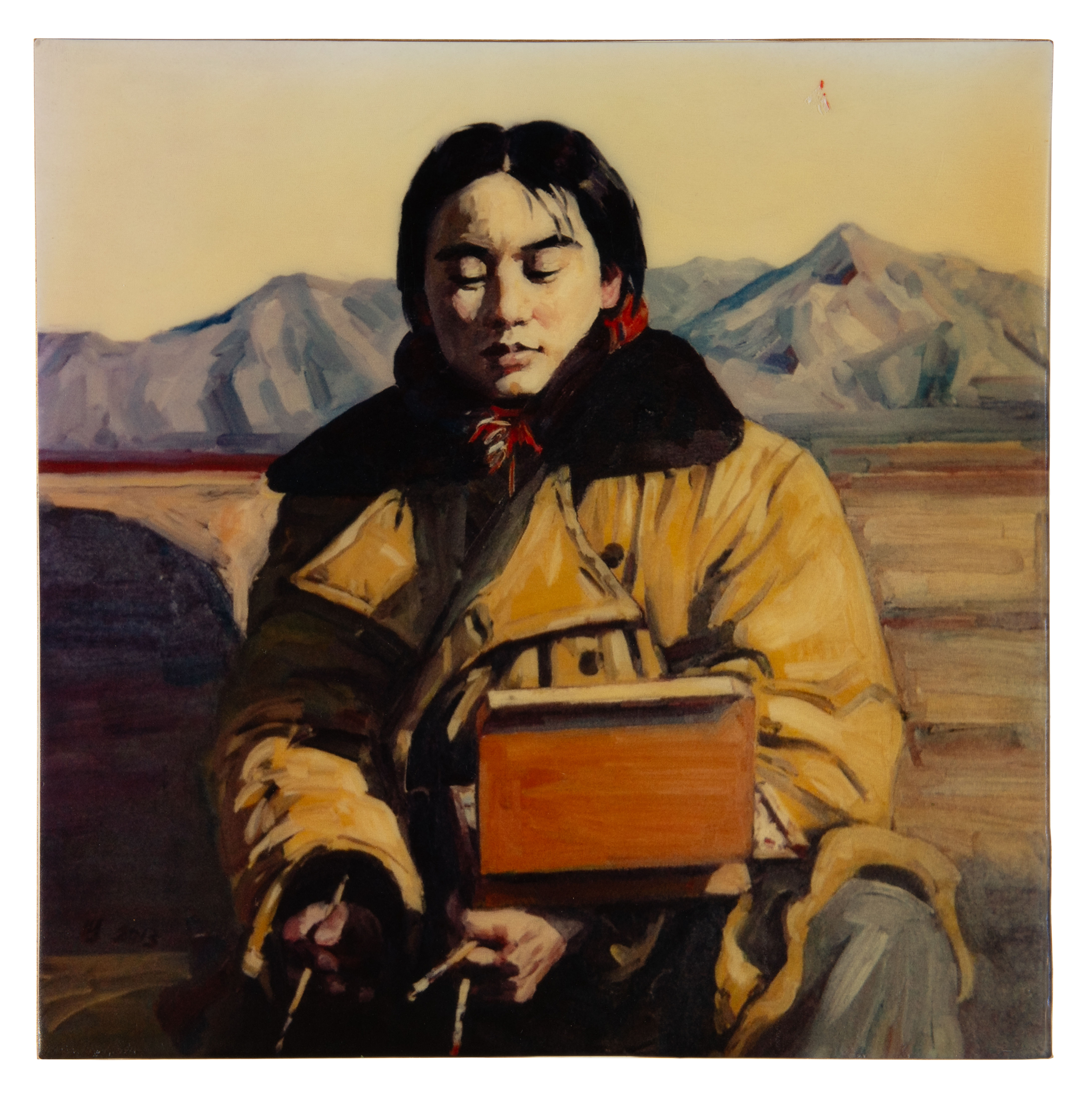
Hung Liu, Unknown, 2013. Mixed media/resin on wood panel with paint, 13 1/2 x 13 1/2 x 2 in
Decades later, after emigrating to the United States, Liu transformed these photographs into oil paintings as well as mixed-media resin works, including those presented in Mixed Mediations. After her arrival in the United States in 1984, her subject matter shifted toward imagery drawn from Chinese historical photography, as if looking back at her homeland from afar. On Liu’s first return trip to China in 1991, she discovered early-twentieth-century photographs in the Beijing Film Archive depicting young Chinese women hired to pose in professional photo studios for the urban sex trade. These images became the basis for large, often shaped canvases she painted in the early 1990s, earning critical acclaim in San Francisco and New York. Mixed Mediations contrasts the intimate scale and immediacy of Liu’s village portraits—including self-portraits—with two large-scale works derived from archival studio photographs of Chinese women posed for Western male viewers, made as Liu reconsidered China from the perspective of her new life in the United States.
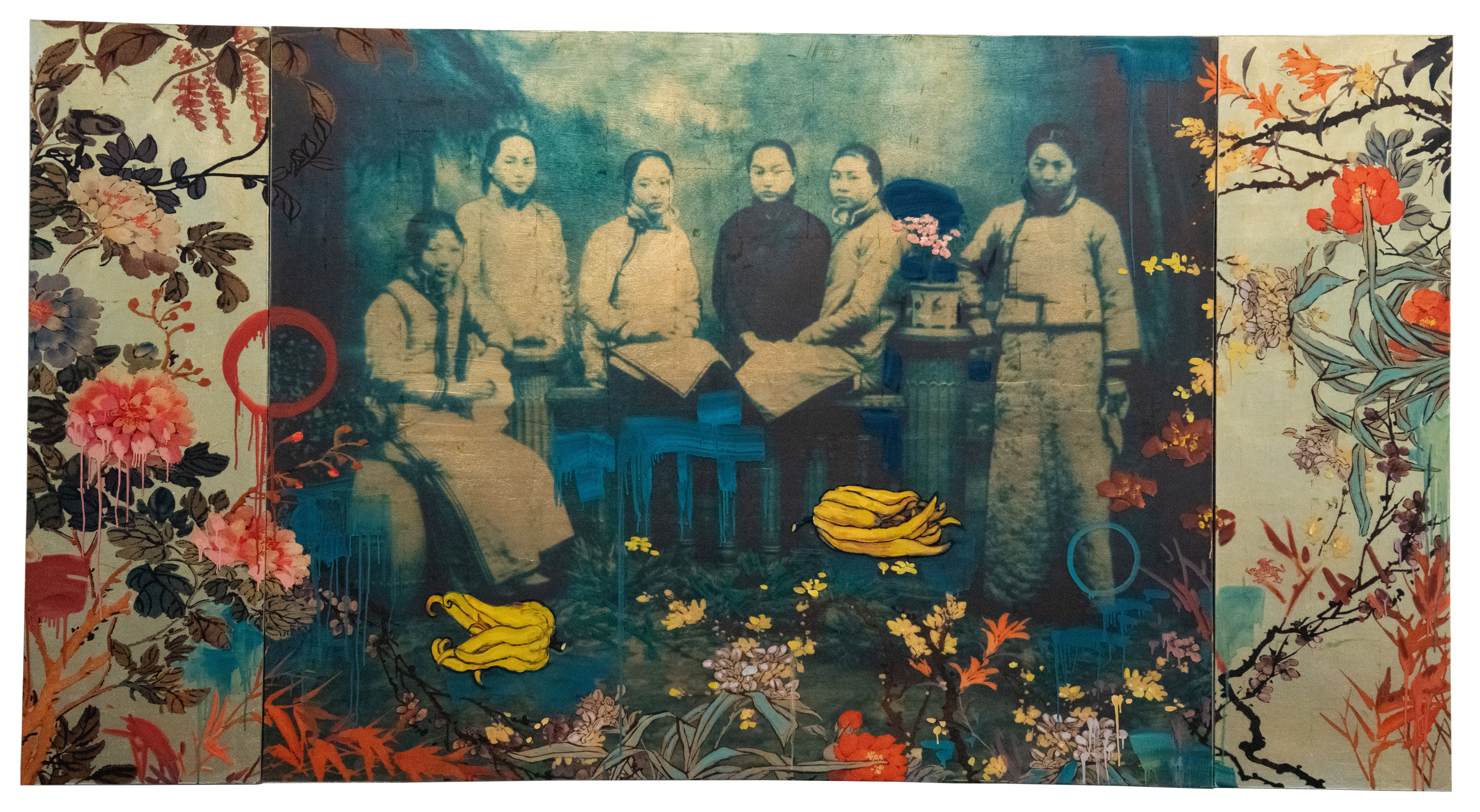
All three bodies of work—village portraits, countryside self-portraits, and photo-studio portraits of young sex workers—are represented in the exhibition as mixed-media reinterpretations that function simultaneously as digital prints and unique works. A recipient of a lifetime achievement award in printmaking, Liu experimented extensively by recycling imagery from her own paintings into new media, including the resin-based works shown here. Each piece begins with painted or photographic images digitally printed onto prepared wooden surfaces, sealed in resin, and then hand-painted by the artist using various colors of printer’s ink. Through this process, layers of mechanical reproduction are transformed by the artist’s hand into singular works. They are not prints, but paintings by other means—hybrids that unite printmaking techniques with the act of painting.
Assembled from forty-two pencil portraits of villagers Liu lived and worked alongside, self-portraits made from mirrors or period photographs, and two large, complex compositions depicting young sex workers posed in professional studio settings, the works in the exhibition convey the immediacy of sketch portraiture, the reflective gaze of self-portraiture, and the staged extravagance of commercial studio photography. While the women in the latter works remain anonymous figures from the countryside who labored in urban centers, the villagers Liu portrayed were known to her personally. Most had never been photographed or even sketched. In this sense, the village portraits function as a communal record of the people with whom Liu shared daily life.
Communist Party orthodoxy during the Cultural Revolution demanded that art “serve the people,” resulting in countless idealized images of heroic peasants, workers, and soldiers. In contrast, Liu’s portraits of her “country-fellows,” as she called them, are specific, observational, and at times eccentric. Rather than ennobling abstract ideals, they capture the particularities of individual faces—their distinct topographies and personalities. When Liu returned to her village in 2003, many surviving residents remembered her fondly and recalled sitting for her portraits.
In 2021, the year of Hung Liu’s death, the Smithsonian National Portrait Gallery presented Hung Liu: Portraits of Promised Lands, a retrospective exhibition of Liu’s portraiture. The exhibition brought together village photographs, countryside sketches, and monumental portraits of sex workers. As feminist theorist Lucy Lippard observed in the exhibition catalogue, “much of [Liu’s] work focuses on the redemption of marginalized women through what might be called the body politic.” Throughout her career—from her earliest sketches and photographs to her final works—Liu approached portraiture as an act of witnessing. Whether monumental or intimate, her portraits present their subjects as active participants who command attention and frequently return the viewer’s gaze. The works on view at Qualia Contemporary Art offer a glimpse into how Liu activated her archive and reveal her approach to portraiture as both archival practice and historical documentation, inviting viewers to bear witness alongside her to lives and histories long erased.
– Adapted from curatorial text by Jeff Kelley with Dorothy Moss
Guillermo Galindo: Tortoise
messages, variations, interpretations
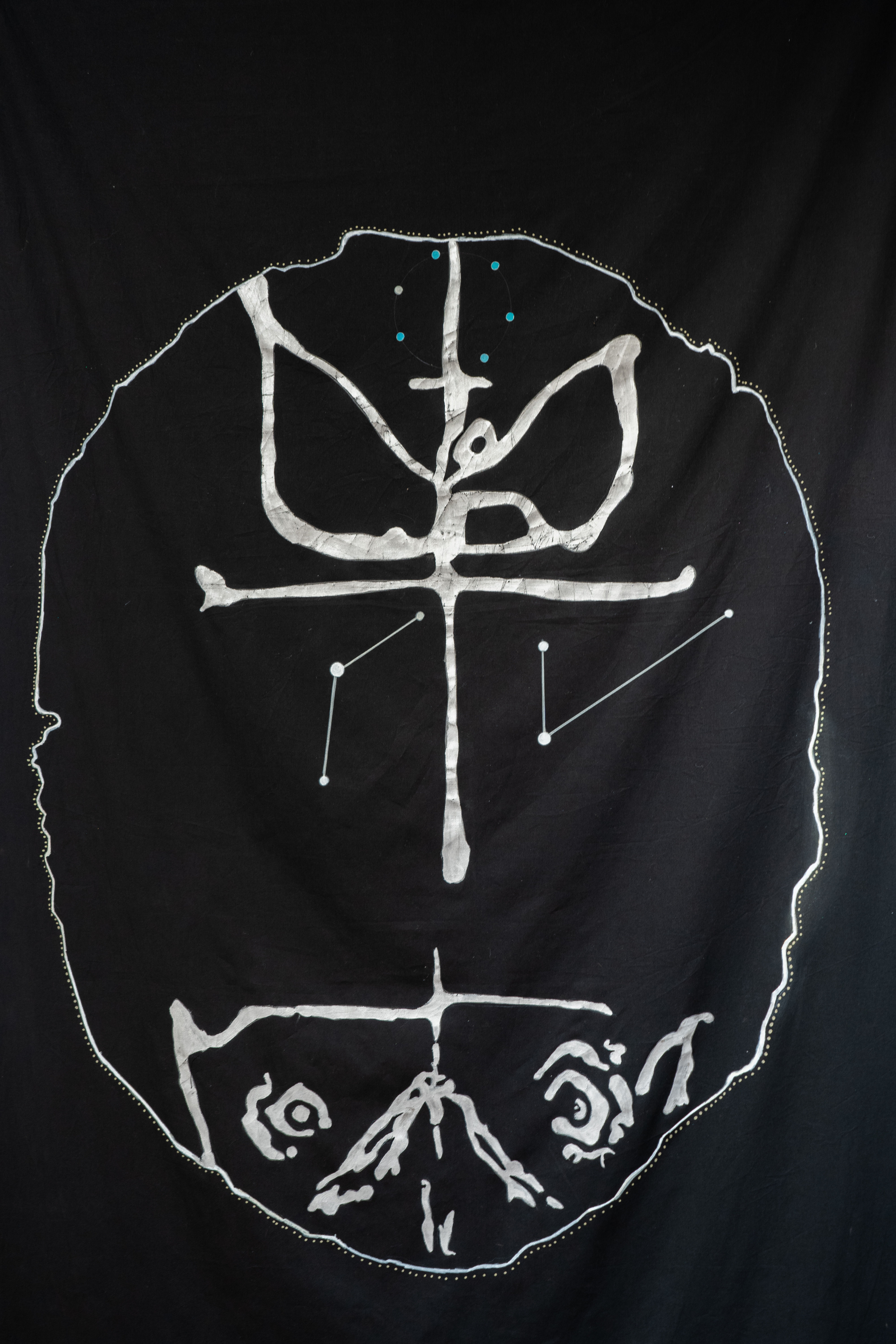
Guillermo Galindo: Tortoise is a solo exhibition of new work by Mexican-American composer, visual artist, and experimental musician Guillermo Galindo. The exhibition continues Galindo’s exploration of borders – metaphysical, geographic, political, philosophical, ecological, and beyond. His broad conceptual focus employs an expansive interpretation of what constitutes a border, whether it be a liminal realm between dreams and consciousness or the differentiation of sound and vision. Tortoise will feature a series of paintings of tortoise shells collected by the artist during his yearlong residency at Roswell, New Mexico, and a selection of double exposure photographic prints with graphic interventions.
Tortoise is anchored by Galindo’s investigation of tortoises as symbols of migration, intuition, longevity, and wisdom, contextualized by his longstanding interest in border constructs. Fascinated by the tortoise’s unique capacity to navigate between land and water and to reorient to its birthplace, Galindo views the tortoise as a type of universal clock through which events are eternally synchronized. Tortoises exemplify Carl Jung’s theory of transcendent function, in which the psyche is able to reconcile forces of opposition between the unconscious and conscious realms. The confluence of physical memory, as in the tortoise’s ability to use the Earth’s magnetic field as a geolocator, and temporal memory, as in the natural grooved patterns of the tortoise’s lower shell (the “plastron”), can be felt in Galindo’s paintings of tortoise shells.

Both Galindo’s paintings and the double-exposure photographs refer to the two tortoise shells that he found in the desert of New Mexico as a Roswell-artist-in-residence. Galindo’s work references the tortoise’s many meanings as a recurring archetype across cultures and time periods. For example, Galindo was inspired by the Shang Dynasty-era practice of “plastromancy,” a form of divination using turtle shells that was practiced in ancient China. In the “scutes” – the individual growth plates on the plastron that can be used to calculate the tortoise’s age, similar to a tree ring – Galindo has interpreted and decoded a portrait of the sentient entity within the shell, giving it visibility in his paintings. The natural seams and patterns of the shell are akin to the symbols of music notation in Galindo’s practice: signifiers of meaning within systems of visual iconography.
“Shells crack. Time speaks.”
The exhibition will open with a live sonic ritual invoking the ancient practice of turtle divination, or plastromancy, in which the turtle shell functions as a symbol of cosmic order and a bearer of worlds. In this performance by Guillermo Galindo, with guest master percussionist William Winant, turtle shells become both oracle and instrument. Their resonant chambers channel ancestral patterns through rhythm and reverberation. Each resonance is a consultation with deep time; each vibration, a pattern emerging from the carapace’s ancient geometry.

