


This article seeks to rediscover an artist of profound cultural significance and reposition her as part of early postwar Asian American and Asian diasporic art. Yau’s work reflects on the meaning of artistic creation, bridging nationalistic histories and experiences of geopolitical upheaval and bodily struggle. Viewing her work through a cross-cultural lens enhances our understanding of Asian American and international contemporary art’s historical depth.
This essay also hopes to draw attention to underexplored historiographical questions within the broader discipline of art history: How do we write a global modernist art history, and what challenges face those creating art from the margins?
Victoria Yau’s “Mountain Cloud” encapsulates the global and local nature of diasporic Asian women’s art and the intricate complexities of international contemporary art. For her, abstraction and poetics were the most faithful expressions of her inner artistic engagement: her dream landscapes, her mountain clouds.

Installation view: Victoria Yau: Mountain Cloud
Victoria Yau (1939–2023), an artist born in Shanghai, created approximately 700 works after relocating to the United States from Taipei.
Spanning nearly half a century, these works reflect her artistic journey through the Pacific Northwest, Chicago, New York, and the American Southwest. They stand as a testament to her unwavering commitment to abstract art and her deep engagement with material experimentation. Her pieces—across various media and often accompanied by her writings and poetry—express a transformation of East Asian landscape painting, shifting from traditional compositional structures to simplified forms that emphasize texture and line.
These works and texts explore how Yau processed geopolitical shifts, migration experiences, and bodily struggles throughout her seventy-year artistic career. Modern in their minimalism, her works are deeply resonant within historical and international contexts. Her concept of “Mountain Cloud” is a poetic reimagining of the traditional term “mountain and water” (shanshui), revealing the complexities of contemporary international art through the lens of an Asian immigrant woman artist.

Installation view: Victoria Yau: Mountain Cloud
Victoria Yau moved to the United States at age 21 and over her lifetime produced more than 700 abstract ink paintings, watercolors, mixed media collages, prints, and textiles—some of which, unfortunately, have been lost. She was best known for her contemplative acrylic landscapes, which were widely exhibited and praised during her career, though her work in other media remained relatively lesser known. These works span nearly five decades of artistic practice and locations, highlighting her devotion to abstraction and experimentation. Her paintings, writings, and poetry together reflect how Asian American artists reimagined East Asian landscape painting—moving from an emphasis on brushwork and composition to explorations in line, color, and material.
Born as Xunmei in Shanghai, Yau later moved to Taipei. She trained in traditional Chinese calligraphy and landscape painting in her youth, studying under notable painters such as Sun Duoci (1913–1975), Fu Juanjie (1910–2007), and Wu Yongxiang (1913–1970)—prominent figures in the 20th-century international ink painting movement. Her early training under Sun Duoci laid the foundation for a lifelong engagement with landscape painting and sparked her enduring interest in ink on paper. After moving to the U.S. in 1960, her work began shifting toward abstraction.

Installation view: Victoria Yau: Mountain Cloud
Yau was a passionate reader and writer. She studied at National Taiwan University as an undergraduate and later at UCLA, eventually earning a philosophy degree from the University of Puget Sound. In 1994, she published an academic article on color theory in the British Journal of Aesthetics. Having left her homeland at twenty, she faced the complexities of American society, culture, and a predominantly white art world as one of the few early postwar Asian American women artists.
Her artwork emphasizes the connection between textures, lines, and shapes observed in nature and those found in everyday objects. Through a refined visual language, she challenged traditional landscape representations. Her paintings merged historical concepts of ink landscape with principles of modern abstract expressionism. Repeating dots, lines, and ink marks highlighted bodily presence, process, and perception. Through her prose and poetry, her practice was marked by thoughtful interpretations of form and color. These elements offered viewers an experience of time’s passage and the abstraction of matter.
Two notable works embody her interest in developing ink landscapes into linear abstraction and material surface.
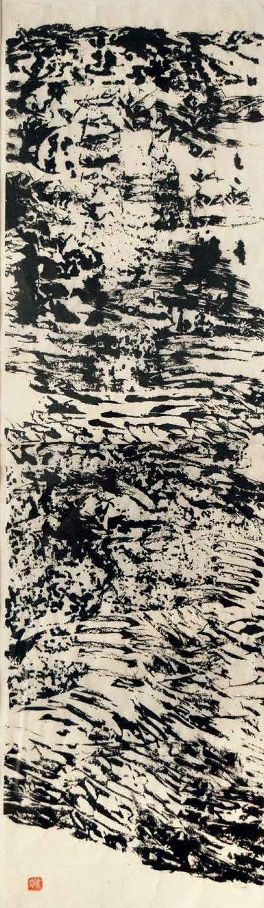
VICTORIA YAU, Hillside Junction, 1979, monoprint, 121.9 x 35.6 cm
"Hillside Junction", completed around 1979, evokes a hanging scroll through its printed landscape. Dark, saturated ink marks rush diagonally toward the bottom right, traversing the canvas horizontally. Dynamic ink dots and strokes suggest mountain trails, waterfalls, and leaves. Viewers, looking from the bottom up, perceive a sloping terrain formed by dry and wet ink marks. Through dynamic ink arrangement, Yau compressed space and echoed the Yuan Dynasty literati painters—such as Wang Meng (c.1308–1385)—who moved toward calligraphic brushwork.
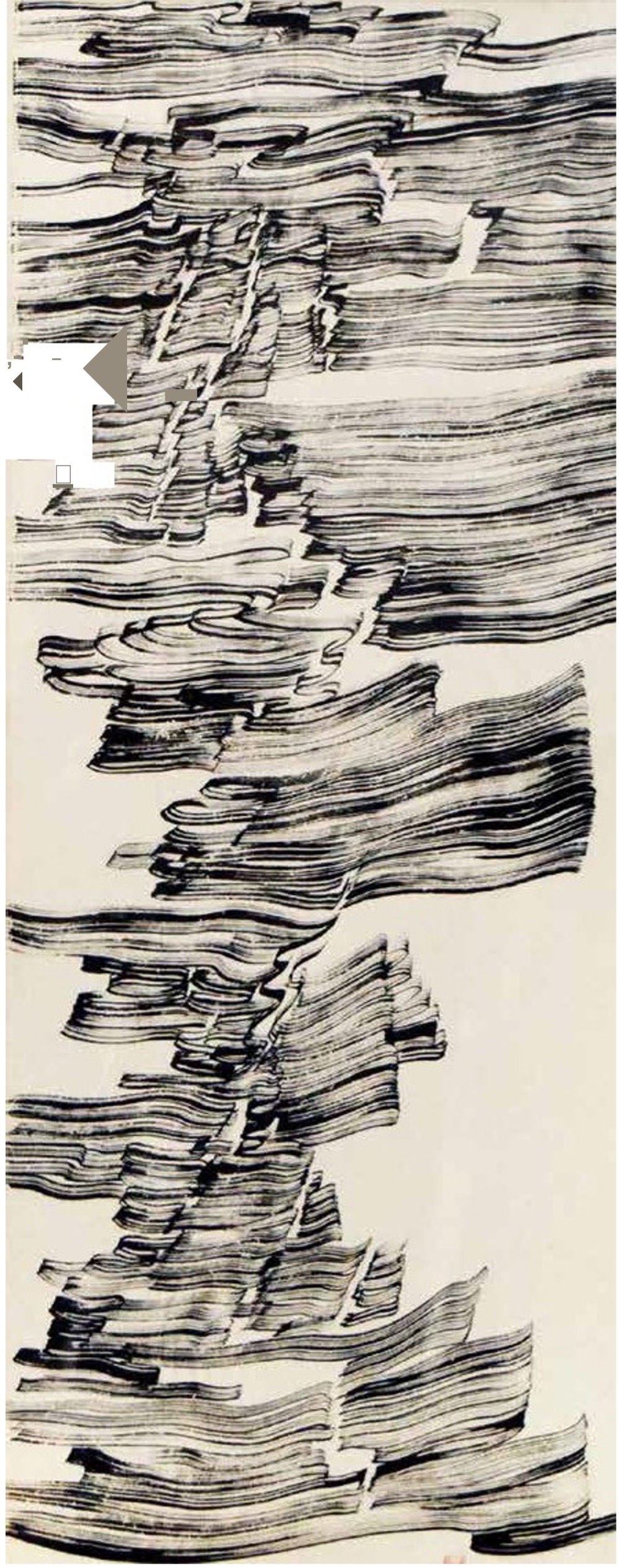
VICTORIA YAU, Rain Dance, 1981 ink on paper, 93.9 x 34.3 cm
In another work, "Rain Dance", linework dominates the composition. Repeating stripes of ink form undulating waves, zigzagging across the paper with energy. Areas left blank serve as negative space, guiding the eye along a watery composition that moves to the rhythm of falling rain.
While raising her family and young son, Yau also worked in local communities as an artist and designer. She was an artist-in-residence and volunteer at the Evanston Art Center, where she expanded her ink landscapes into printmaking and mixed media. In her collages—such as the meteoric "In The Beginning"—she explored the materiality of paper through cutting, crumpling, folding, and layering, allowing texture and shape to play an active role in the work. She liberated paper from its traditional role as a support for ink landscape, instead emphasizing its ability to evoke forms, colors, and textures found in nature, such as rock formations, mountains, and snow. These personal encounters with landscapes fueled her imagination throughout her life.

VICTORIA YAU, In the Beginning, 1982, watercolor collage on paper, 107.3 x 73.7 cm
During the 1980s and 1990s, Yau lived in Arizona and the American Southwest due to her husband’s career. The physical landscapes—comprising varied geology and new terrains—had a profound impact on her art. She often wrote:
“Travel absolutely enriches my visual expression.”
Her home and studio were filled with landscape photographs she had taken. Her travels allowed her to collect traces of nature—found objects, stones, shells, feathers. She would later arrange them into miniature landscapes, inspiring her to integrate such textures into her art. For example, "Canyon Love" applied ink and pigment on xuan paper to express the subtle shifts in color and sediment layers.
Yau often wrote that her art was her “true daughters,” the daughters she “never had in her physical life.” As a mother of two sons, she brought maternal care into her creative process, extending nurturing to her artistic practice. Her writings are rare and vivid accounts from an artist of her generation, background, and multilingual environment. One surviving text is an unfinished family biography, tracing her maternal lineage back to the late Qing Dynasty (19th century). Art history has long focused on male Chinese landscape painters; Yau’s steadfast engagement with landscape challenges and revises these narratives. As a mother and woman artist, she made ink painting her own language—a way to express her being. She painted with the heart, creating landscapes of her own.

Installation view: Victoria Yau: Mountain Cloud
She wrote more than once:
“My artworks are like my daughters... They represent my private space. What is the most intimate space in a house? Most would say the bedroom. For me, [it is] the bathroom...”
Humor, too, seemed to be one of her strengths.
As a diasporic Chinese woman artist, Yau used art to cope with the turbulence of migration and sought to build bridges between artistic worlds—from Shanghai to Taipei and across the U.S. Her art, writings, and poetry highlight her unique voice as a woman artist living and working amid the transitions of the postwar world. She questioned whether landscapes could convey emotion and emphasized the importance of creating art in the everyday, even if that everyday was mundane—or full of displacements.
Like the scholar-painters of China’s Ming and Qing dynasties, Victoria Yau was both a painter and a poet. In one poem, she wrote:
The mountains follow the clouds
The clouds follow the mountains
Echoing longing
(River Dream, 2005)
Her concept of “Mountain Cloud” is a reinterpretation of the historical term “shanshui” (mountain-water), and a recurring theme in her poetry and imagery. The selected works in this publication showcase her monochrome prints, watercolor collages, and ink paintings—landscapes rendered in their most minimal and elemental forms.
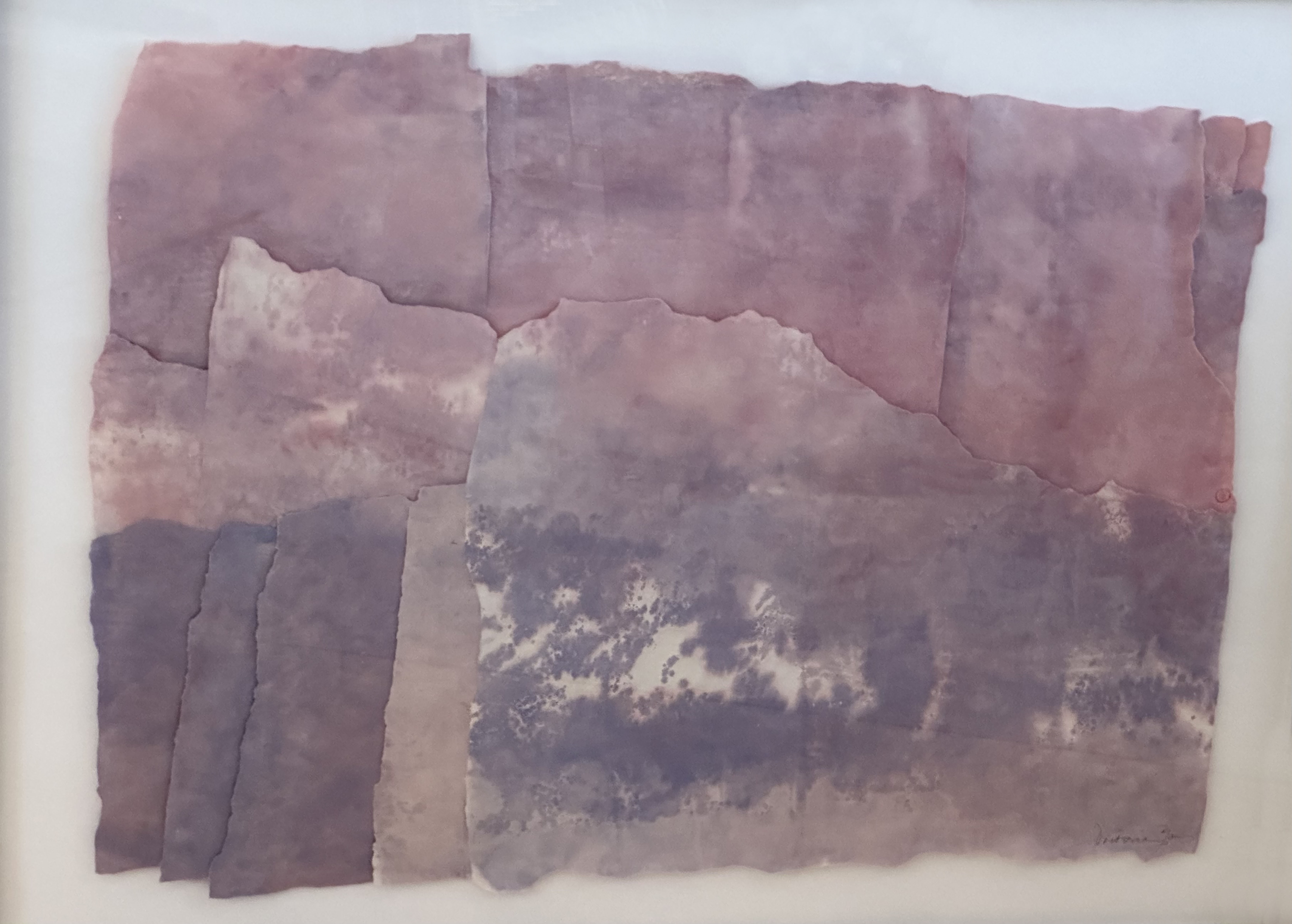
VICTORIA YAU, Canyon From The Side, 1988, watercolor collage on paper, 70.5 x 94.6 cm
For instance, "Canyon From The Side" uses color, collage, and juxtaposed materials to highlight natural textures. "Rain" utilizes ink and printing techniques to depict rapid rainfall through linear markings. In her later years, she returned to ink painting, pushing abstraction further by embracing material chance and effect.
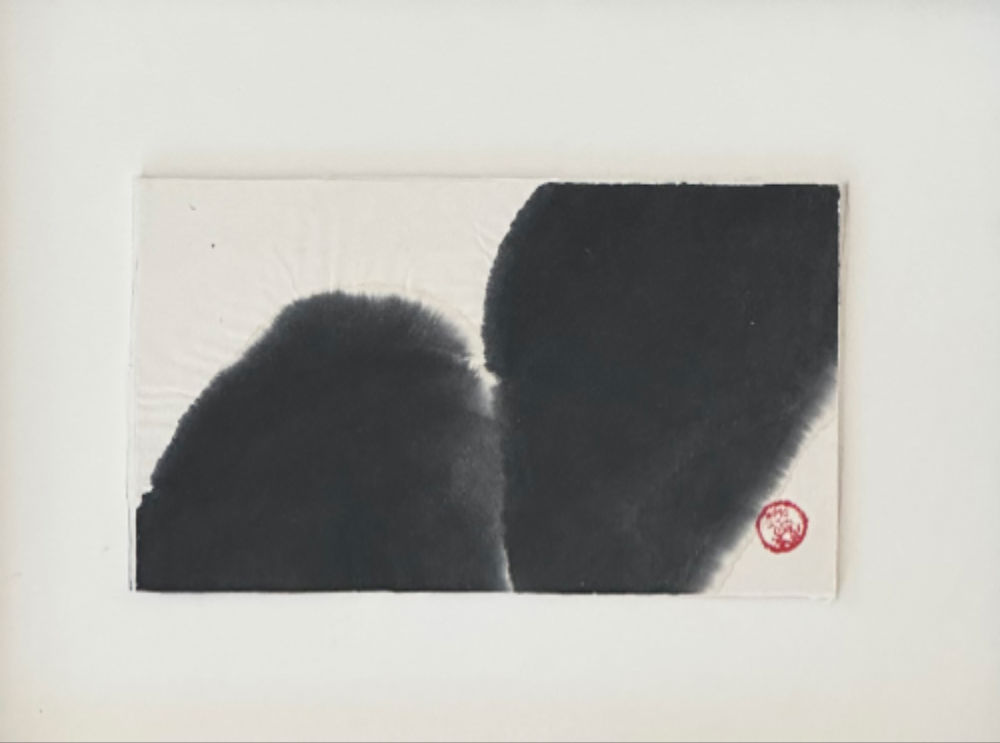
In works like her waterscape "Dancing Water", rockscape "Kissing Stones", and natural renderings like "Dewdrop", the interaction between ink and paper created physical wrinkles, enhancing the sense of diagonal motion. In "Meandering Path" and similar pieces, she exploited the absorbent qualities of paper to generate unique crinkling effects: ink and paper interacting to dynamically alter the artwork’s surface, emphasizing texture and a strong material presence.

