
Hung Liu: Mixed Mediations: Village Sketches, Studio Poses, and Countryside Self-Portraits in China


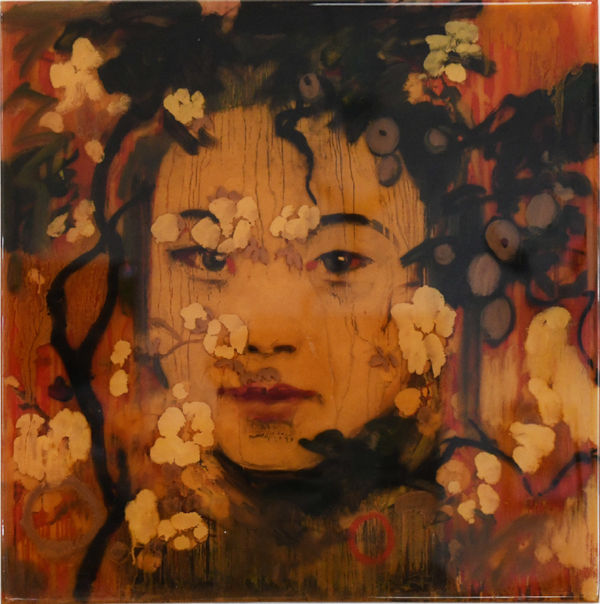
During the Cultural Revolution in China, Hung Liu worked from 1968 to 1972 as a peasant farmer in the countryside northeast of Beijing. As an artist, she sketched whenever possible, producing quick yet incisive likenesses of her fellow villagers. Some drawings were completed on the spot, while others were refined years later in the studio. Liu also owned a German 120 camera with a Carl Zeiss lens, given to her by a young man about to be sent to a military labor camp. With no prior photographic training, she taught herself to shoot, develop, and print black-and-white photographs. During her years in the countryside, she photographed fellow villagers—many of whom had never been photographed before. At times, she staged photographs of herself, such as sitting on a washed-out bridge, along a riverbank, or painting in the hills.
Decades later, after emigrating to the United States, Liu transformed these photographs into oil paintings as well as mixed-media resin works, including those presented in Mixed Mediations. After her arrival in the United States in 1984, her subject matter shifted toward imagery drawn from Chinese historical photography, as if looking back at her homeland from afar. On Liu’s first return trip to China in 1991, she discovered early-twentieth-century photographs in the Beijing Film Archive depicting young Chinese women hired to pose in professional photo studios for the urban sex trade. These images became the basis for large, often shaped canvases she painted in the early 1990s, earning critical acclaim in San Francisco and New York. Mixed Mediations contrasts the intimate scale and immediacy of Liu’s village portraits—including self-portraits—with two large-scale works derived from archival studio photographs of Chinese women posed for Western male viewers, made as Liu reconsidered China from the perspective of her new life in the United States.
All three bodies of work—village portraits, countryside self-portraits, and photo-studio portraits of young sex workers—are represented in the exhibition as mixed-media reinterpretations that function simultaneously as digital prints and unique works. A recipient of a lifetime achievement award in printmaking, Liu experimented extensively by recycling imagery from her own paintings into new media, including the resin-based works shown here. Each piece begins with painted or photographic images digitally printed onto prepared wooden surfaces, sealed in resin, and then hand-painted by the artist using various colors of printer’s ink. Through this process, layers of mechanical reproduction are transformed by the artist’s hand into singular works. They are not prints, but paintings by other means—hybrids that unite printmaking techniques with the act of painting.
Assembled from forty-two pencil portraits of villagers Liu lived and worked alongside, self-portraits made from mirrors or period photographs, and two large, complex compositions depicting young sex workers posed in professional studio settings, the works in the exhibition convey the immediacy of sketch portraiture, the reflective gaze of self-portraiture, and the staged extravagance of commercial studio photography. While the women in the latter works remain anonymous figures from the countryside who labored in urban centers, the villagers Liu portrayed were known to her personally. Most had never been photographed or even sketched. In this sense, the village portraits function as a communal record of the people with whom Liu shared daily life.
Communist Party orthodoxy during the Cultural Revolution demanded that art “serve the people,” resulting in countless idealized images of heroic peasants, workers, and soldiers. In contrast, Liu’s portraits of her “country-fellows,” as she called them, are specific, observational, and at times eccentric. Rather than ennobling abstract ideals, they capture the particularities of individual faces—their distinct topographies and personalities. When Liu returned to her village in 2003, many surviving residents remembered her fondly and recalled sitting for her portraits.
In 2021, the year of Hung Liu’s death, the Smithsonian National Portrait Gallery presented Hung Liu: Portraits of Promised Lands, a retrospective exhibition of Liu’s portraiture. The exhibition brought together village photographs, countryside sketches, and monumental portraits of sex workers. As feminist theorist Lucy Lippard observed in the exhibition catalogue, “much of [Liu’s] work focuses on the redemption of marginalized women through what might be called the body politic.” Throughout her career—from her earliest sketches and photographs to her final works—Liu approached portraiture as an act of witnessing. Whether monumental or intimate, her portraits present their subjects as active participants who command attention and frequently return the viewer’s gaze. The works on view at Qualia Contemporary Art offer a glimpse into how Liu activated her archive and reveal her approach to portraiture as both archival practice and historical documentation, inviting viewers to bear witness alongside her to lives and histories long erased.
– Adapted from curatorial text by Jeff Kelley with Dorothy Moss
